
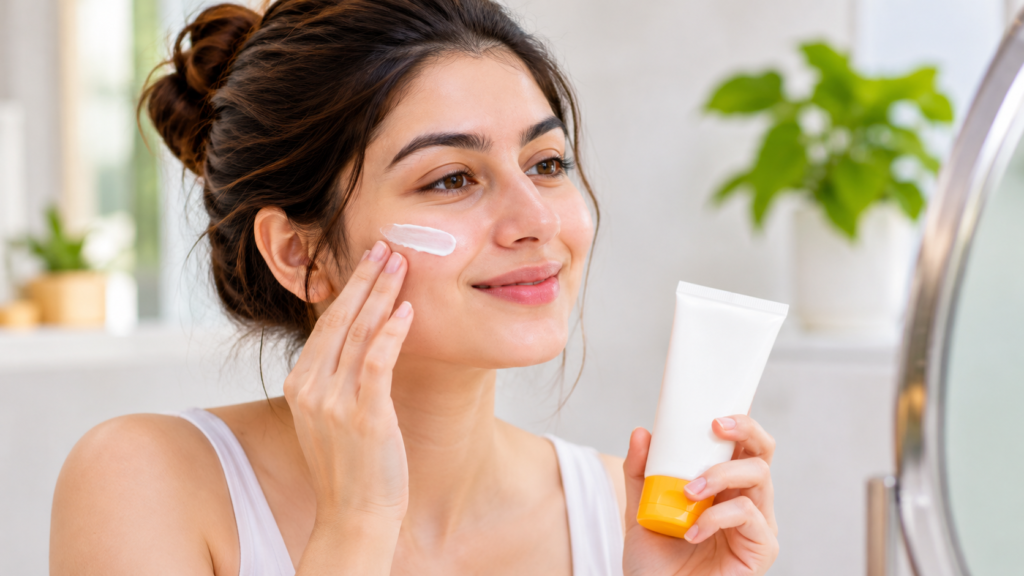

Applying sunscreen every day is an important part of a healthy skincare routine. However, choosing a good sunscreen is only half the job. The amount you apply also matters.
Many people use only a small amount of sunscreen because they worry about a greasy finish, white cast or heavy feeling on their skin. Unfortunately, applying too little sunscreen may reduce the level of protection you receive.
So, how much sunscreen should you actually apply to your face? Should you follow the two-finger rule, and how often should you reapply it?
Let’s understand the right amount, application method and common mistakes to avoid.
How Much Sunscreen Should You Apply on Your Face?
For most adults, a useful guideline is approximately 1 teaspoon of sunscreen for the face. The American Academy of Dermatology (AAD) recommends at least this amount to cover the face adequately.
The exact amount can vary slightly depending on your face size, product texture and how evenly you spread it. The important thing is to apply enough to create an even layer over all exposed skin.
Remember that your neck is a separate area and needs additional sunscreen.
What Is the Two-Finger Rule for Sunscreen?
The two-finger rule is a popular method for estimating sunscreen quantity.
To follow this method:
- Take your sunscreen tube.
- Squeeze a line of sunscreen along the length of your index finger.
- Squeeze another line along your middle finger.
- Apply the sunscreen evenly over your face.
This method gives you a convenient visual estimate, but the amount can vary depending on the sunscreen tube opening and product consistency.
For a more reliable guideline, the AAD recommends at least one teaspoon for the face. Do not assume that two finger-lengths provide exactly the same amount with every product.
How to Apply Sunscreen Correctly on Your Face
Applying sunscreen properly helps you get the protection indicated on its label.
Follow these simple steps:
Step 1: Cleanse Your Face
Start with a gentle cleanser to remove excess oil, sweat and dirt. Pat your face dry with a clean towel.
If you already have a morning skincare routine, you can follow it before applying sunscreen.
Step 2: Apply Your Moisturizer
If your skin needs extra hydration, apply a suitable moisturizer first.
Allow it to settle before applying sunscreen. This helps you layer your skincare products comfortably without mixing them together.
Step 3: Measure the Right Amount
Use approximately one teaspoon of sunscreen for your face as a practical starting guideline.
Avoid applying only a tiny amount to save product. Too little sunscreen may not provide the protection shown on its label.
Step 4: Spread It Evenly
Apply sunscreen across your forehead, cheeks, nose and chin. Pay attention to areas that are commonly missed, including the sides of your nose, hairline and jawline.
Spread the product gently and evenly. Avoid getting sunscreen directly into your eyes.
Step 5: Do Not Forget Your Neck and Ears
Your face is not the only area exposed to sunlight. Apply sunscreen to your neck and ears as well.
If your lips are exposed, use a lip balm with SPF 30 or higher.
Step 6: Apply It Before Going Outdoors
Follow the product instructions. Many sunscreen labels recommend applying sunscreen approximately 15 minutes before sun exposure.
If you are going outside, make sure you have applied it before leaving home.
How Much SPF Should Your Sunscreen Have?
The Sun Protection Factor (SPF) indicates how well a sunscreen protects against UVB rays when used as directed.
For everyday sun protection, choose a broad-spectrum sunscreen with SPF 30 or higher.
Here is a simple comparison:
- SPF 15: Provides a lower level of UVB protection.
- SPF 30: Filters approximately 97% of UVB rays under test conditions.
- SPF 50: Filters approximately 98% of UVB rays under test conditions.
No sunscreen blocks 100% of UVB rays. Higher SPF also does not mean you can skip reapplication.
Look for broad-spectrum protection because it covers both UVA and UVB rays.
How Often Should You Reapply Sunscreen?
Applying sunscreen once in the morning may not be enough if you spend time outdoors throughout the day.
As a general guideline:
- Reapply approximately every two hours when outdoors.
- Reapply after swimming or heavy sweating.
- Reapply after towel drying.
- Follow the specific instructions on your sunscreen label.
If you spend most of your day indoors and away from direct sunlight, your reapplication needs may differ. However, prolonged outdoor exposure, outdoor work and activities near windows can make sun protection more important.
Common Sunscreen Application Mistakes to Avoid
Even a good sunscreen may not provide its intended protection if you use it incorrectly.
Watch out for these common mistakes:
#1. Applying Too Little Sunscreen
One of the most common mistakes is using a very small amount. Apply enough to cover all exposed skin evenly.
#2. Forgetting the Neck and Ears
People often apply sunscreen only to their cheeks and forehead. Remember to protect your neck, ears and other exposed areas.
#3. Skipping Sunscreen on Cloudy Days
Clouds do not completely block UV radiation. Sun protection can still be important on cloudy days.
#4. Mixing Sunscreen with Moisturizer
Avoid mixing sunscreen directly with moisturizer or foundation. Doing so can affect how evenly the sunscreen forms a protective layer.
Apply your skincare products in separate layers instead.
#5. Not Reapplying During Outdoor Activities
Sweating, swimming and towel drying can reduce sunscreen coverage. Reapply according to the label instructions.
#6. Choosing Sunscreen Only by SPF Number
SPF is important, but you should also look for broad-spectrum protection and suitable water-resistance claims when needed.
Sunscreen Tips for Different Skin Types
The right sunscreen should offer suitable protection while feeling comfortable on your skin.
For oily skin: Consider lightweight, non-comedogenic or gel-based formulas if you prefer a less greasy finish.
For dry skin: A moisturizing sunscreen or cream-based formula may feel more comfortable.
For sensitive skin: Look for a gentle formula with ingredients your skin tolerates. Mineral sunscreens containing zinc oxide or titanium dioxide may be an option.
For acne-prone skin: Consider products labelled non-comedogenic, which are formulated to be less likely to clog pores. Individual reactions can still vary.
If you are unsure which formula suits your skin, introduce a new product gradually.
Can You Apply Sunscreen Over Makeup?
Yes, you can reapply sunscreen over makeup, but it can be difficult to maintain an even layer using some application methods.
Some people use sunscreen sticks, powders or sprays for convenience. However, these products may be difficult to apply in sufficient quantities or evenly over the entire face.
For dependable protection, use a suitable sunscreen as the final step of your morning skincare routine before makeup. When reapplying, choose a method that allows you to cover all exposed skin adequately.
Frequently Asked Questions About Sunscreen Application
#1. Is one teaspoon of sunscreen enough for the face?
The AAD recommends at least one teaspoon for most adults when applying sunscreen to the face. You may need a little more depending on your face size and how much skin you need to cover.
#2. Is the two-finger rule enough for the face?
The two-finger rule is a convenient estimation method, but the amount varies with the tube opening and product texture. One teaspoon is the AAD’s recommended minimum guideline for the face.
#3. Should I apply sunscreen before or after moisturizer?
Apply moisturizer first and sunscreen afterward. Allow your moisturizer to settle before applying sunscreen as a separate, even layer.
#4. Do I need sunscreen if I stay indoors?
It depends on your surroundings and exposure. If you sit near windows or spend time outdoors during the day, sunscreen can be useful. UVA rays can pass through ordinary window glass.
#5. Can I use sunscreen on my neck and hands?
Yes. Apply sunscreen to all exposed skin, including your neck, ears and hands. These areas are often missed during daily skincare routines.
#6. How long should I wait before going outside after applying sunscreen?
Many sunscreen labels recommend applying the product approximately 15 minutes before sun exposure. Always follow the directions on your specific product.
#7. Does applying more sunscreen increase SPF protection?
Using enough sunscreen helps you achieve the protection indicated on the product label. Applying more than the recommended amount does not change the labelled SPF, but applying too little can reduce the protection you receive.
#8. Should I reapply sunscreen if I am not sweating?
If you are spending time outdoors, reapply approximately every two hours even if you are not sweating. Follow the product’s instructions and reapply after swimming or towel drying.
Conclusion:
Using sunscreen correctly is just as important as choosing the right product. Applying approximately one teaspoon to your face, covering all exposed areas and reapplying when needed can help you get the protection your sunscreen is designed to provide.
Choose a formula that feels comfortable on your skin so you can use it consistently. Remember that sunscreen works best alongside other sun-protection habits, such as wearing protective clothing, using sunglasses and seeking shade.
For more practical information, explore our Sun Protection Guide.
Skincare References
The following trusted sources provide additional guidance on sunscreen quantity, application and sun protection:
- American Academy of Dermatology – How to Apply Sunscreen
- American Academy of Dermatology – Sunscreen FAQs
- U.S. Food and Drug Administration – Sunscreen: How to Help Protect Your Skin from the Sun
- American Academy of Dermatology – Common Sunscreen Mistakes
Disclaimer: This article is for general informational purposes only and is not a substitute for professional skincare advice. Before trying any skincare product or changing your routine, consult a qualified skincare or healthcare professional to make sure it is suitable for your skin.
About Author


