
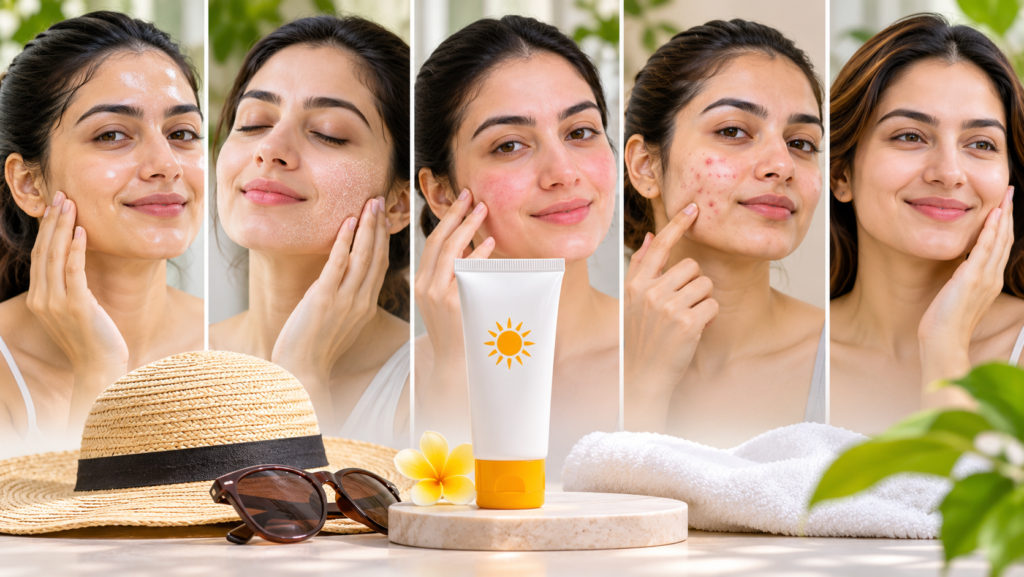

Finding a sunscreen that suits your skin can sometimes feel confusing. Some formulas leave an oily finish, others feel too heavy, and certain products may cause irritation or leave a visible white cast.
The problem is not always the sunscreen itself. Sometimes, the formula simply does not suit your skin type.
Whether you have oily, dry, sensitive, combination or acne-prone skin, choosing a comfortable sunscreen can make daily sun protection easier. The important thing is to look beyond the texture and check whether the product offers reliable UV protection.
In this guide, you will learn how to choose sunscreen for your skin type, which ingredients and textures to consider, and what to check before buying a product.
What Should You Look for in Any Sunscreen?
Before choosing a sunscreen based on your skin type, check these three important features on the label.
#1. Broad-Spectrum Protection
Choose a sunscreen labelled broad-spectrum. This means it protects against both UVA and UVB rays.
UVA rays contribute to premature skin ageing and pigmentation, while UVB rays are a major cause of sunburn.
#2. SPF 30 or Higher
For everyday sun protection, choose a sunscreen with SPF 30 or higher. SPF indicates the level of protection against UVB rays when the product is applied correctly.
A higher SPF does not mean you can apply less sunscreen or skip reapplication.
#3. Water Resistance
If you exercise outdoors, sweat heavily or go swimming, consider a water-resistant sunscreen.
Check the label to see whether the product offers 40 or 80 minutes of water resistance. No sunscreen is completely waterproof.
For more information, read our complete Sun Protection Guide.
How to Choose Sunscreen for Different Skin Types
Every skin type has different needs. A formula that feels comfortable on oily skin may not provide enough comfort for someone with dry skin.
Here is what to consider when selecting sunscreen.
#1. Sunscreen for Oily Skin
If your face becomes shiny shortly after washing, you may have oily skin. You might also notice excess oil around your forehead, nose and chin.
Heavy or greasy sunscreen formulas can feel uncomfortable, especially during hot and humid weather.
What to look for:
- Lightweight gel or fluid sunscreen.
- Oil-free formulas if you prefer a less oily finish.
- Non-comedogenic products that are formulated to be less likely to clog pores.
- A comfortable, non-greasy finish.
Gel-based sunscreens are often a convenient option for people with oily skin. However, the overall formulation matters more than the product’s texture alone.
Helpful tip: Do not skip sunscreen because your skin already produces excess oil. Instead, try a lightweight formula that you feel comfortable wearing every day.
#2. Sunscreen for Dry Skin
Dry skin often feels tight, rough or flaky, particularly after washing your face. A sunscreen with a comfortable moisturizing formula may make your morning routine easier.
What to look for:
- Cream-based or moisturizing sunscreen.
- Glycerin for hydration.
- Ingredients such as ceramides that support the skin barrier.
- A formula that does not leave your skin feeling tight.
Some sunscreens already contain moisturizing ingredients, so you may not need to apply a separate moisturizer underneath if the sunscreen provides enough comfort.
Helpful tip: If your skin is very dry, apply a suitable moisturizer before sunscreen. Let it settle, then apply sunscreen as a separate layer.
#3. Sunscreen for Sensitive Skin
Sensitive skin may react to certain skincare ingredients with redness, itching, stinging or discomfort.
If you frequently experience these reactions, choose sunscreen carefully rather than trying several new products at once.
What to look for:
- Fragrance-free formulas.
- Products labelled for sensitive skin.
- Mineral sunscreen containing zinc oxide or titanium dioxide.
- Simple formulations that your skin tolerates.
Mineral sunscreens may be a suitable starting point for people whose skin stings when using other sunscreen formulas. However, no sunscreen is guaranteed to suit everyone.
Helpful tip: Test a new product on a small area of skin before applying it regularly to your face. Stop using it if you develop irritation.
#4. Sunscreen for Combination Skin
Combination skin usually has more than one skin characteristic. For example, your forehead and nose may become oily while your cheeks feel dry.
This can make choosing sunscreen slightly confusing.
What to look for:
- Lightweight lotion or gel-cream formulas.
- A comfortable finish that does not feel too greasy.
- Enough moisturizing support for dry areas.
- Non-comedogenic options if you are prone to clogged pores.
You do not necessarily need separate sunscreens for different parts of your face. Start with one balanced formula and see how your skin responds.
Helpful tip: If your cheeks feel dry, use a suitable moisturizer underneath sunscreen on those areas rather than choosing an unnecessarily heavy sunscreen for your entire face.
#5. Sunscreen for Acne-Prone Skin
If you frequently experience pimples, blackheads or clogged pores, choosing sunscreen can be challenging. You may worry that it will make breakouts worse.
However, avoiding sunscreen is not a good solution, particularly when you are using skincare treatments that can increase sun sensitivity.
What to look for:
- Non-comedogenic sunscreen.
- Lightweight gel or fluid textures if you dislike heavy products.
- Fragrance-free options if your skin is easily irritated.
- A formula that works comfortably with your existing acne skincare routine.
Remember that non-comedogenic does not guarantee that a product will never cause breakouts. Individual skin reactions can vary.
Helpful tip: Avoid introducing several new skincare products at the same time. This makes it easier to identify which product may be causing a reaction.
#6. Sunscreen for Normal Skin
Normal skin generally does not feel excessively oily or dry. People with this skin type may have more flexibility when choosing sunscreen textures.
What to look for:
- Cream, lotion, gel or fluid sunscreen.
- Broad-spectrum protection.
- SPF 30 or higher.
- A comfortable finish suitable for everyday use.
You do not need a complicated formula just because your skin is normal. Choose a sunscreen that provides the protection you need and feels pleasant enough to use consistently.
Which Sunscreen Texture Is Best for Your Skin?
The texture of sunscreen can influence how comfortable it feels throughout the day.
Here is a simple comparison:
| Sunscreen texture | May suit |
|---|---|
| Gel | Oily skin and people who prefer a lightweight feel |
| Cream | Dry skin |
| Lotion | Normal and combination skin |
| Fluid | People who prefer a lightweight application |
| Stick | Convenient application around smaller areas, such as the eye area |
| Spray | Convenient for body application when used according to label directions |
These are general preferences, not strict rules. A well-formulated gel may also suit combination skin, while some creams can work comfortably on oily skin.
The best choice is one that provides adequate protection and suits your skin’s needs.
Mineral vs Chemical Sunscreen: Which Should You Choose?
You may have noticed that sunscreens are often described as mineral or chemical.
The main difference is the type of UV-filtering ingredients they contain.
Mineral Sunscreen
Mineral sunscreens use zinc oxide, titanium dioxide or both as active UV filters.
They may be worth considering if your skin is sensitive or tends to sting with other sunscreen products.
However, some mineral formulas can leave a white cast, particularly on deeper skin tones.
Chemical Sunscreen
Chemical sunscreens use other UV-filtering ingredients to absorb UV radiation.
Many modern formulas have lightweight textures and spread easily on the skin.
Some people with sensitive skin may experience irritation with particular formulas, so individual tolerance matters.
Which One Is Better?
Neither type is automatically better for everyone.
Choose a broad-spectrum sunscreen with SPF 30 or higher that suits your skin and that you can apply in an adequate amount. If you have sensitive skin, you may prefer starting with a mineral formula.
How to Choose Sunscreen for Darker Skin Tones
People with darker skin tones also need daily sun protection. More melanin does not provide complete protection against UV damage.
One common concern is the white cast left by some sunscreen formulas.
Here are a few things to consider:
- Try tinted sunscreen if you want a formula that blends more naturally with your skin tone.
- Check whether the tint matches your complexion.
- Look for broad-spectrum SPF 30 or higher.
- Consider products containing iron oxides if visible-light protection is important for pigmentation concerns.
Tinted sunscreen containing iron oxides can offer additional protection against visible light, which may worsen some pigmentation concerns.
Common Mistakes to Avoid When Choosing Sunscreen
Choosing the right sunscreen is not only about your skin type. Some common buying mistakes can also affect your daily sun protection.
- Choosing only by SPF: Check broad-spectrum protection and water-resistance claims too.
- Ignoring your skin’s reactions: Stop using products that repeatedly cause irritation.
- Buying heavy formulas for convenience: A product that feels uncomfortable may be difficult to use consistently.
- Assuming mineral sunscreen is always better: Both mineral and chemical sunscreens can provide effective protection.
- Applying too little: Use enough sunscreen to cover exposed skin evenly.
- Skipping sunscreen on cloudy days: UV exposure can still occur when the sky is overcast.
How to Apply Sunscreen Correctly
Even a suitable sunscreen needs proper application.
Follow these basic steps:
- Cleanse your face with a gentle cleanser.
- Apply moisturizer if your skin needs additional hydration.
- Apply sunscreen as a separate layer.
- Cover your forehead, cheeks, nose, chin, jawline and other exposed areas.
- Apply it before going outdoors according to the product instructions.
- Reapply approximately every two hours when outdoors, and after swimming, sweating or towel drying.
For a more detailed explanation, read our upcoming guide on How Much Sunscreen Should You Apply on Your Face? once it is published.
FAQs.
Q1. How do I know which sunscreen is suitable for my skin type?
Start by understanding whether your skin is oily, dry, combination, sensitive or acne-prone. Then choose a comfortable formula with broad-spectrum protection and SPF 30 or higher. You may need to try a few suitable products to find one your skin tolerates.
Q2. Which sunscreen texture is best for oily skin?
Gel and lightweight fluid formulas are popular choices for oily skin. Look for non-comedogenic options if you are concerned about clogged pores.
Q3. Can people with dry skin use gel sunscreen?
Yes. A gel sunscreen can be used on dry skin if it feels comfortable and does not leave your skin tight. You can apply a moisturizer underneath if additional hydration is needed.
Q4. Is mineral sunscreen better for sensitive skin?
Mineral sunscreen containing zinc oxide or titanium dioxide may be a good option for people who experience stinging with other formulas. However, individual reactions vary, so check the ingredients and test the product carefully.
Q5. Does oily skin need sunscreen every day?
Yes. Oily skin still needs sun protection. Choose a lightweight, non-comedogenic formula if heavy products feel uncomfortable.
Q6. Can I use the same sunscreen in summer and winter?
Yes, provided it offers suitable broad-spectrum protection and works comfortably for your skin. You may prefer a different texture depending on the weather, humidity and your skin’s condition.
Q7. Does sunscreen prevent tanning and dark spots?
Sunscreen helps reduce UV exposure that contributes to tanning and pigmentation. However, no sunscreen blocks all UV radiation, and it cannot guarantee that dark spots or tanning will never occur.
Q8. Should I change my sunscreen when my skin type changes?
Your skin can feel different with changes in weather, age, hormones and skincare routines. If your current sunscreen becomes uncomfortable, consider a formula that better suits your skin’s current needs while maintaining adequate sun protection.
Final Thoughts
Choosing sunscreen becomes much easier when you understand what your skin actually needs. Oily skin may feel more comfortable with a lightweight formula, while dry skin may prefer a moisturizing cream. Sensitive and acne-prone skin may benefit from carefully selected, gentle and non-comedogenic products.
Do not focus only on popular brands or high SPF numbers. Look for broad-spectrum protection, SPF 30 or higher and a formula you can use consistently.
The right sunscreen is ultimately the one that protects your skin and fits comfortably into your everyday routine.
Skincare References
For additional information about sunscreen selection and sun protection, explore these reliable resources:
- American Academy of Dermatology – How Do I Know If I’m Using the Right Sunscreen?
- American Academy of Dermatology – How to Select a Sunscreen
- American Academy of Dermatology – Sunscreen FAQs
- Indian Sunscreen Forum – Practical Recommendations for Indians on Sunscreen Use
Disclaimer: This article is for general informational purposes only and is not a substitute for professional skincare advice. Before trying any skincare product or changing your routine, consult a qualified skincare or healthcare professional to make sure it is suitable for your skin.
About Author


