
Jojoba oil is a popular ingredient in skincare products, including facial oils, moisturisers and cleansers. It is often discussed as an option for people who want to moisturise their skin without using a heavy-feeling oil. However, if you have oily or acne-prone skin, you may wonder: Is jojoba oil comedogenic, and can it clog pores?
Jojoba oil is generally considered to have a low comedogenic potential in many skincare ingredient guides. However, this does not guarantee that it will suit every skin type. The way your skin responds can depend on the product formulation, how much you apply and your individual skin sensitivity.
In this article, we will explore what jojoba oil is, what research says about its skincare uses, whether it can contribute to clogged pores and what to consider before adding it to your routine.
What Is Jojoba Oil?
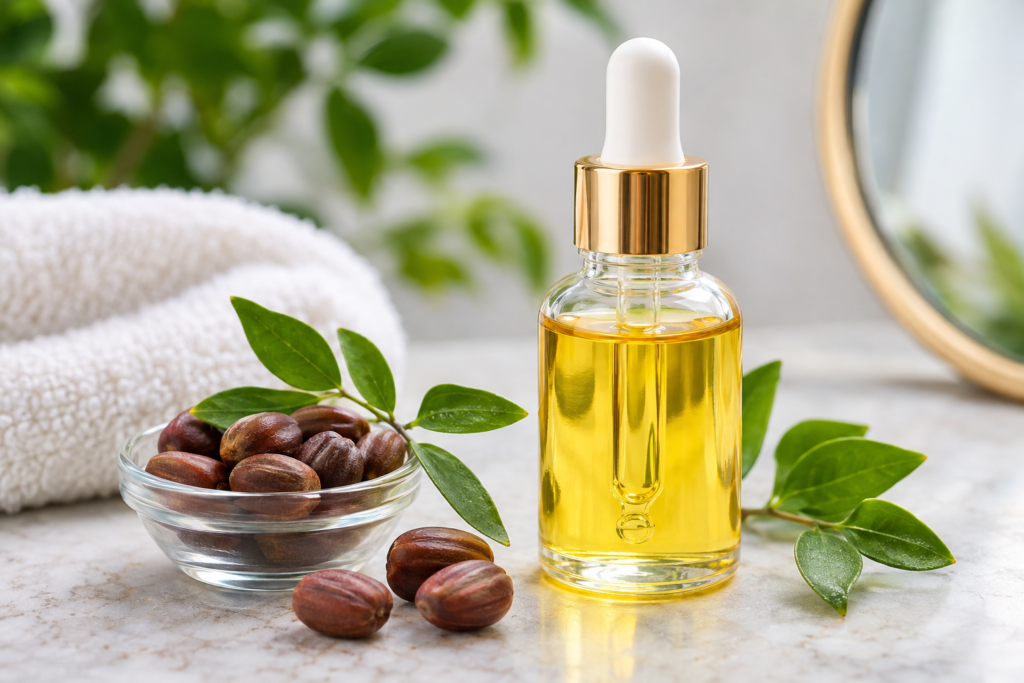
Jojoba oil comes from the seeds of the jojoba plant (Simmondsia chinensis). Despite its name, it is technically a liquid wax rather than a conventional plant oil. It is made mainly of wax esters, which give it a composition different from many other cosmetic oils.
Jojoba oil is commonly used in skincare formulations because it acts as an emollient. Emollients help soften the skin and improve its feel. You may find jojoba oil in facial moisturisers, cleansing products, lip balms and body-care products.
Its use in skincare does not automatically mean that every product containing it will suit every person. The overall formulation and your skin’s response are also important.
Is Jojoba Oil Comedogenic?
Jojoba oil is commonly described as a low-comedogenic ingredient. Some ingredient-rating guides place it around 0–2 on the traditional 0–5 comedogenic scale.
However, this rating should be understood as a general reference rather than a scientifically guaranteed result for human skin.
Comedogenicity ratings are often based on older ingredient-testing methods. They do not always predict how an ingredient will behave when used on the human face or when combined with other ingredients in a finished product.
There is also limited human research directly establishing whether jojoba oil clogs pores. Therefore, it would be inaccurate to say that jojoba oil is completely non-comedogenic or that it can never contribute to breakouts.
The practical answer: Jojoba oil is generally considered to have low pore-clogging potential, but individual reactions can vary.
Can Jojoba Oil Clog Pores?
It is possible for someone to experience clogged pores or breakouts after using a skincare product containing jojoba oil. However, this does not automatically prove that jojoba oil was responsible.
Several factors can influence how your skin responds:
- Individual skin differences: The same ingredient may suit one person but not another.
- Product formulation: A skincare product contains multiple ingredients, and the complete formula matters.
- Amount applied: Applying a thick layer may feel uncomfortable or too heavy for some skin types.
- Other skincare products: Using several rich products together may not suit everyone’s routine.
- Skin sensitivity: Some people may experience irritation or an allergic reaction to an ingredient.
If you notice new or worsening bumps after introducing a product, stop using it temporarily and observe your skin. Avoid assuming that every breakout is caused by jojoba oil alone.
Is Jojoba Oil Good for Acne-Prone Skin?
Jojoba oil may suit some people with acne-prone skin because it can act as an emollient and help soften dry skin. However, there is not enough strong clinical evidence to recommend it as a standalone acne treatment.
A 2012 pilot study examined a clay facial mask containing jojoba oil in people with acne-prone or lesioned skin. Participants reported improvements after using the mask, but the study evaluated a combination of clay and jojoba oil. It could not establish that jojoba oil alone caused the reported changes.
This distinction is important. An ingredient may have a useful role in a skincare formulation without being a proven treatment for acne.
If you experience regular breakouts, focus on a suitable skincare routine and evidence-based acne care rather than relying on facial oils to clear acne.
Potential Skincare Benefits of Jojoba Oil
Jojoba oil is mainly used as a conditioning and moisturising ingredient. Its potential cosmetic uses include the following.
#1. Helps Soften Dry Skin
As an emollient, jojoba oil can help make dry or rough skin feel softer. It is often included in moisturising formulations to improve skin feel.
#2. Helps Reduce Moisture Loss
Oils can help reduce moisture loss by forming a layer on the skin’s surface. Jojoba oil may therefore be useful as part of a moisturising routine, particularly when combined with other suitable skincare ingredients.
#3. Improves Product Texture
Jojoba oil is used in cosmetic formulations because it can improve how a product spreads and feels on the skin.
These are cosmetic and moisturising uses. They should not be confused with proven treatments for acne, pigmentation, eczema or other skin conditions.
Is Jojoba Oil Suitable for Different Skin Types?
Jojoba oil may feel different depending on your skin type and the product formulation.
Oily Skin
If your skin already produces excess oil, you may prefer a lightweight, non-greasy moisturiser. A pure facial oil may feel too heavy for some people. If you want to try jojoba oil, start with a small amount and observe how your skin responds.
You can also read our guide on oily but dehydrated skin to understand why oily skin can still feel dry or tight.
Dry Skin
People with dry skin may find jojoba oil-containing products useful for adding softness and reducing the feeling of dryness. It can be used as part of a broader moisturising routine.
Combination Skin
If your T-zone is oily but your cheeks feel dry, your skin may respond differently in different areas. Pay attention to how each area reacts instead of applying the same amount everywhere.
Sensitive Skin
Sensitive skin can react to different skincare ingredients, including botanical oils. Introduce a new product carefully and stop using it if you notice irritation, itching, redness or swelling.
How to Use Jojoba Oil on Your Face
If you want to try a jojoba oil-containing skincare product, a cautious approach is sensible.
- Check the ingredient list: Look at the complete formulation rather than judging a product by one ingredient.
- Patch test first: Apply a small amount to a limited area of skin and watch for irritation.
- Start with a small amount: Avoid applying a thick layer when trying the product for the first time.
- Introduce one new product at a time: This makes it easier to identify which product may be causing a reaction.
- Observe your skin: Stop using the product if you experience persistent irritation or worsening breakouts.
A patch test can help identify some reactions, but it cannot guarantee that a product will never cause breakouts or irritation.
If you are unsure about the order of your products, read our guide on what order to apply skincare products.
Does Jojoba Oil Cause Acne?
There is no simple yes-or-no answer. Jojoba oil is not established as a common acne trigger for everyone, but no skincare ingredient can be guaranteed to suit all individuals.
It is also important to distinguish between acne and irritation. Small bumps, redness, itching or discomfort after using a product may have different causes. A reaction does not automatically mean that pores have become clogged.
If you experience persistent or painful acne, consider seeking advice from a qualified skincare or healthcare professional instead of relying on facial oils as a treatment.
Common Mistakes to Avoid When Using Jojoba Oil
If you are adding jojoba oil to your routine, avoid these common mistakes:
- Applying too much product at once.
- Assuming that a low comedogenic rating guarantees clear skin.
- Introducing several new skincare products on the same day.
- Ignoring redness, itching or other signs of irritation.
- Using facial oil as a replacement for acne treatment when treatment is needed.
- Assuming that natural ingredients are always suitable for sensitive skin.
A simple routine that suits your skin is often more useful than adding several products without understanding how they work. If you are building a basic routine, see our guide to a simple skincare routine for beginners.
Conclusion
So, is jojoba oil comedogenic? It is generally listed as a low-comedogenic ingredient, but that rating should not be treated as a guarantee. Individual skin responses and the complete product formulation matter more than a single number on a comedogenic scale.
Jojoba oil may help soften dry skin and improve the feel of moisturising products, but current evidence does not establish it as a standalone acne treatment. If you decide to try it, introduce the product gradually, use a small amount and pay attention to how your skin responds.
FAQs.
Q1. Does jojoba oil clog pores?
Jojoba oil is commonly considered to have low pore-clogging potential, but it cannot be guaranteed not to clog pores in every individual. The complete product formulation and personal skin response also matter.
Q2. What is the comedogenic rating of jojoba oil?
Jojoba oil is often listed around 0–2 on the traditional 0–5 comedogenic scale. These ratings are general references, not guarantees of how an ingredient will behave on human skin.
Q3. Is jojoba oil suitable for acne-prone skin?
Some people with acne-prone skin may tolerate it, but it is not a proven standalone acne treatment. Introduce it carefully and monitor your skin.
Q4. Can jojoba oil cause pimples?
It is possible to experience breakouts after using a product containing jojoba oil. However, other ingredients, the overall formulation and individual skin factors may also be responsible.
Q5. Is jojoba oil suitable for oily skin?
Some people with oily skin may tolerate jojoba oil, while others may find a pure oil too heavy. A lightweight moisturiser may be a more comfortable option.
Q6. Can jojoba oil irritate sensitive skin?
Yes, although reactions are not necessarily common. Published case reports describe contact dermatitis associated with jojoba oil. Stop using a product if you experience irritation or an unusual skin reaction.
Q7. Can jojoba oil treat acne?
There is not enough strong evidence to establish jojoba oil as an effective standalone acne treatment. A study of a jojoba-containing clay mask cannot show that jojoba oil alone caused the reported results.
Q8. Should I use jojoba oil every day?
Daily use is not necessary for everyone. Whether it suits your routine depends on your skin type, the product formulation and how your skin responds.
Research References
The following scientific publications and research sources were consulted while preparing this article:
- Jojoba Oil: An Updated Comprehensive Review on Chemistry, Pharmaceutical Uses, and Toxicity – PubMed Central
- An Updated Review on Efficacy and Benefits of Sweet Almond, Evening Primrose and Jojoba Oils in Skin Care Applications – International Journal of Cosmetic Science
- Clay Jojoba Oil Facial Mask for Lesioned Skin and Mild Acne – PubMed
- Contact Dermatitis from Jojoba Oil – PubMed
- Final Report on the Safety Assessment of Jojoba Oil and Jojoba Wax – International Journal of Toxicology
Disclaimer
This article is for general informational purposes only and is not a substitute for professional skincare advice. Before trying any skincare product or changing your routine, consult a qualified skincare or healthcare professional to make sure it is suitable for your skin.
About Author

