
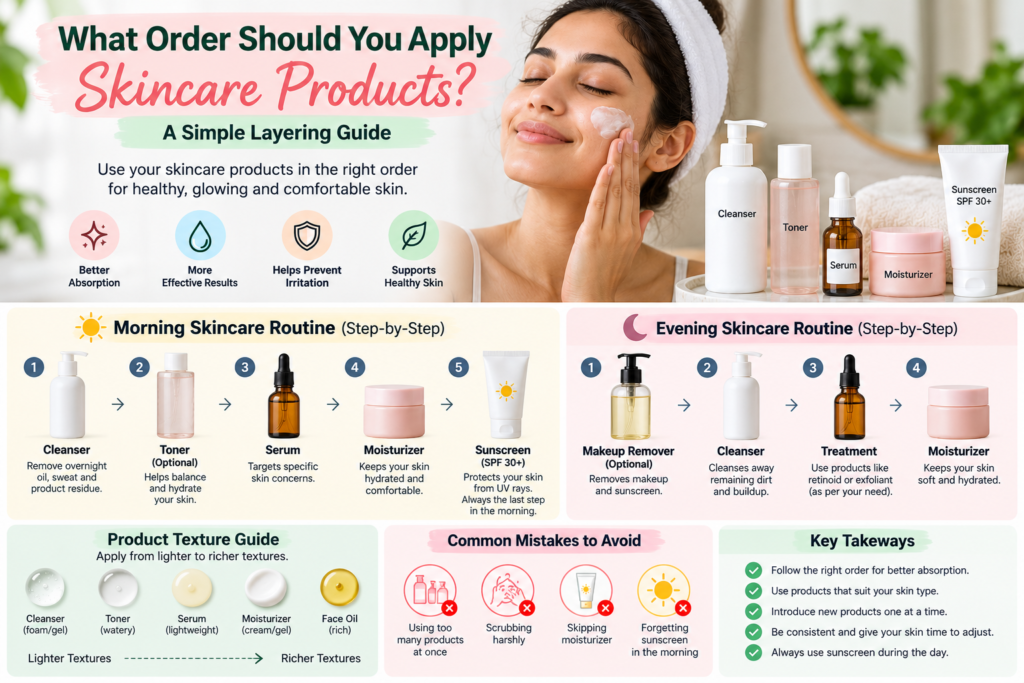

Have you ever wondered whether your serum should go on before or after moisturizer—or if sunscreen belongs at the beginning or the end of your routine? Skincare product order can feel confusing, especially when you’re using more than just a cleanser and cream.
The good news is that you don’t need a complicated routine. In general, apply products from lighter textures to richer ones, and use sunscreen as the final step of your morning skincare routine.
This guide explains a practical order for common skincare products, what to do in the morning and evening, and how to avoid layering products in a way that irritates your skin.
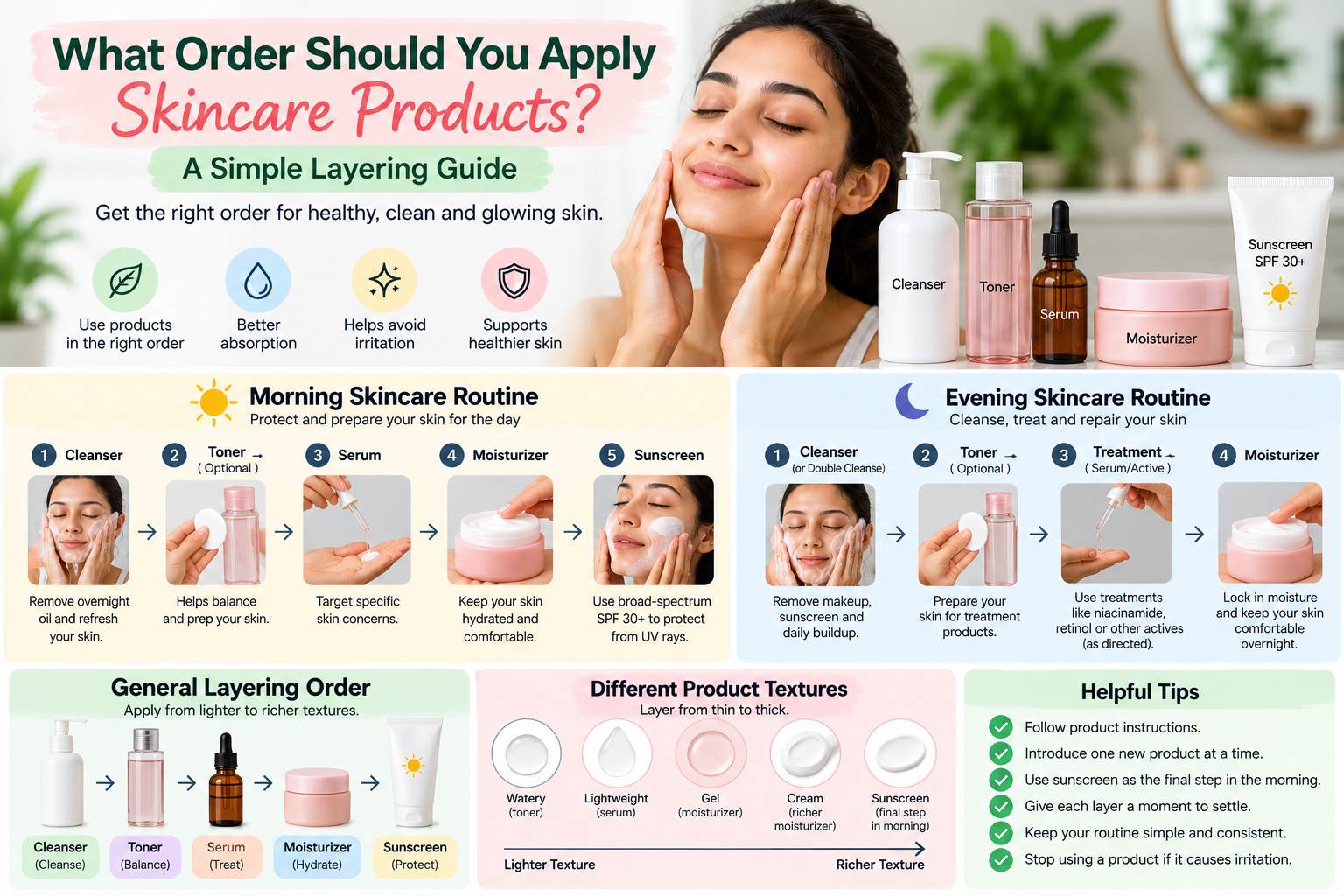
The Basic Rule for Layering Skincare
A helpful starting point is to apply products in this order:
- Cleanser
- Toner or essence, if you use one
- Serum or treatment
- Moisturizer
- Sunscreen in the morning
This is a general guide, not a strict rule for every formula. Product labels may give specific directions, so follow them when they differ. If you use only a cleanser, moisturizer and sunscreen, that simple routine is perfectly fine.
If you’re new to skincare, you may also find our guide to building a simple skincare routine for beginners helpful.
Morning Skincare: What Goes First?
Your morning routine should cleanse gently, moisturize as needed and protect your skin from UV exposure.
#1. Cleanser
Start with a gentle cleanser to remove overnight sweat, oil or product residue. If your skin feels dry or sensitive in the morning, a water rinse may be enough for some people.
Use lukewarm water and avoid harsh scrubbing.
#2. Toner or Essence (Optional)
Some people use a toner or essence after cleansing. These products vary widely: some are hydrating, while others contain exfoliating or treatment ingredients.
You don’t need a toner simply because it is part of a popular routine. If you use one, follow its instructions and choose a formula that suits your skin.
#3. Serum or Treatment
Apply your serum after cleansing and any toner or essence. Serums may contain ingredients such as vitamin C, niacinamide or hyaluronic acid, but you don’t need to use all of them.
- Vitamin C: Often used in morning routines, but follow the product’s directions and introduce it gradually if your skin is sensitive.
- Niacinamide: Can be used in different routines; choose a formula and frequency that your skin tolerates.
- Hyaluronic acid: Often included in hydrating products. Apply as directed and follow with moisturizer if needed.
If you want to combine ingredients, read our guide on using niacinamide and vitamin C together.
#4. Moisturizer
Moisturizer helps keep skin comfortable and supports its moisture barrier. Apply it after your serum or treatment, unless the product label says otherwise.
Choose a texture that feels suitable for your skin. A lightweight lotion may feel comfortable for oily skin, while a richer cream may suit skin that feels dry.
#5. Sunscreen
Apply broad-spectrum sunscreen with SPF 30 or higher as the final step of your morning skincare routine, before makeup.
Follow the sunscreen’s directions for how much to apply and when to reapply. Reapply as directed, particularly after swimming, sweating or towel-drying. Sunscreen works best alongside other sun-protection habits, such as seeking shade and wearing protective clothing.
Evening Skincare: What Order Should You Follow?
Your evening routine is a chance to remove sunscreen, makeup and daily buildup, then moisturize.
#1. Remove Makeup or Sunscreen if Needed
If you wear makeup or water-resistant sunscreen, you may prefer a makeup remover, cleansing oil or balm before your regular cleanser. Whether you need two cleansing steps depends on the products you use and how your skin feels.
Avoid rubbing the skin harshly.
#2. Cleanser
Wash with a gentle cleanser to remove remaining residue. If your skin feels tight or irritated afterward, consider switching to a milder cleanser.
#3. Treatment Product
If you use a treatment—such as an exfoliating product or a retinoid—apply it according to its label. Some treatments are intended for evening use, while others have different directions.
Start slowly rather than using several new active products on the same night. Avoid applying irritating products to broken or already irritated skin.
#4. Moisturizer
Finish with moisturizer to help keep your skin comfortable. If a treatment product’s instructions specify a different order, follow those directions.
Where Do Eye Creams and Face Oils Fit?
Eye Cream
Eye creams are optional. If you use one, apply it gently around the area indicated on the label. Depending on its texture, it may go before or after your moisturizer; there is no single order that applies to every eye product.
Avoid getting skincare products into your eyes.
Face Oil
Face oils are often applied toward the end of a routine because they can feel richer than watery serums. However, formulas differ, so follow the label and see how the oil sits with your other products.
If layering makes your skin feel greasy, sticky or uncomfortable, simplify the routine.
Does Skincare Always Have to Go from Thin to Thick?
“Thin to thick” is a useful rule of thumb, but it does not solve every product-layering question. Different formulas behave differently, and some products have specific application instructions.
When in doubt:
- Follow the product label.
- Introduce one new product at a time.
- Give each layer a moment to settle if products are pilling or feeling uncomfortable.
- Use fewer products if your routine is irritating your skin.
If a product causes persistent burning, swelling, a rash or significant discomfort, stop using it. Seek professional advice if symptoms are severe, persistent or worsening.
Common Skincare Layering Mistakes
Applying too many products: More layers do not automatically mean better skincare. A basic routine can be enough.
Starting several active ingredients together: If irritation occurs, it can be hard to tell which product caused it. Add products one at a time.
Skipping moisturizer: Some treatment products can leave skin feeling dry or uncomfortable. Moisturizer may help support skin comfort.
Applying sunscreen too early: In a typical morning routine, sunscreen is the final skincare step before makeup.
Ignoring product directions: Some formulas have specific instructions about frequency, order or use with other products. Read the label rather than relying only on general layering advice.
FAQs:
Q1. Should serum go before or after moisturizer?
Serums are generally applied before moisturizer, but follow the product instructions. If a serum has a particular application method, its label takes priority.
Q2. Can I apply two serums in the same routine?
Sometimes, but it depends on their ingredients, formulas and your skin’s tolerance. If you’re new to skincare, start with one serum and add another only if you have a clear reason.
Q3. Should sunscreen go before or after moisturizer?
In a typical morning routine, apply moisturizer first and sunscreen afterward. Sunscreen is generally the last skincare step before makeup.
Q4. Do I need toner?
No. Toner is optional. A cleanser, moisturizer and sunscreen can form a simple routine without it.
Q5. How long should I wait between skincare layers?
There is no universal waiting time for every product. Follow the label and allow layers to settle if needed. If your products repeatedly pill, try using fewer layers or adjusting the amount.
Conclusion:
The right skincare order can make your routine easier to follow, but you don’t need every product category. Start with gentle cleansing, moisturizer and daytime sunscreen. Add a serum or treatment only if it addresses a specific need and your skin tolerates it.
Keep your routine simple, pay attention to how your skin feels, and follow product directions.
Disclaimer: This article is for general informational purposes only and is not a substitute for professional skincare advice. Before trying any skincare product or changing your routine, consult a qualified skincare or healthcare professional to make sure it is suitable for your skin.
About Author


