
Stretch marks are a common skin concern that can develop during pregnancy, puberty, rapid weight changes or muscle growth. They may appear as red, purple, pink, brown or silvery lines on areas such as the abdomen, thighs, hips, breasts and upper arms.
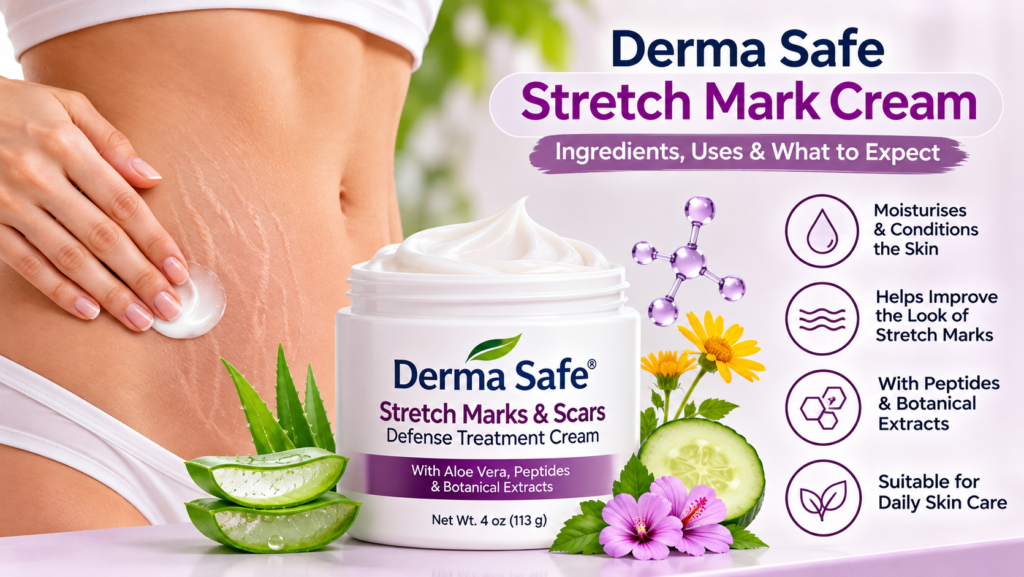
Many skincare products are marketed to reduce the appearance of stretch marks. One such product is Derma Safe Stretch Marks & Scars Defense Treatment Cream, which is listed as containing Aloe Vera, glycerin, peptides and several botanical extracts.
But can Derma Safe cream actually remove stretch marks? What ingredients does it contain, and what should you know before using it?
In this guide, we will look at the product’s listed ingredients, their cosmetic purposes, realistic expectations, application precautions and other options for caring for stretch-marked skin.
What Is Derma Safe Stretch Mark Cream?
Derma Safe Stretch Marks & Scars Defense Treatment Cream is a topical skincare product marketed for the appearance of stretch marks and scars.
The product information on the original listing describes it as a moisturising cream formulated with Aloe Vera, peptides and botanical extracts. Its stated purpose is to condition the skin and improve the appearance of areas affected by stretch marks and scars.
The product listing also identifies its size as 4 ounces and includes ingredients such as:
Aloe Barbadensis Leaf
Glycerin
Rutin
Palmitoyl Oligopeptide
Palmitoyl-Tetrapeptide-7
Butylene Glycol
Cetearyl Alcohol
Cucumber Extract
Arnica Montana Extract
Wild Mallow Extract
Ingredient lists and product formulations can change. Always check the packaging of the product you purchase to confirm the current ingredients and directions.
Important: Marketing descriptions are not the same as independent clinical evidence. The product listing does not, by itself, establish that Derma Safe cream permanently removes stretch marks or scars.
What Causes Stretch Marks?
Stretch marks, medically known as striae, develop when the skin stretches or shrinks relatively quickly. These changes affect the supportive structures in the skin, including collagen and elastin.
Several factors can contribute to their development:
#1. Pregnancy
During pregnancy, the abdomen and other areas may stretch as the body changes. Hormonal changes can also influence the skin’s supportive tissues.
#2. Rapid Weight Changes
Significant weight gain or loss over a relatively short period can contribute to stretch marks on the abdomen, thighs, hips and other areas.
#3. Puberty and Growth Spurts
Rapid physical growth during adolescence can cause stretch marks, particularly around the thighs, hips, breasts and back.
#4. Muscle Growth
People who experience rapid muscle growth through weight training may develop stretch marks around the shoulders, arms and other areas.
#5. Genetic and Hormonal Factors
Family history and hormonal factors can influence how likely someone is to develop stretch marks.
Stretch marks are common and generally harmless. They often become less noticeable over time, although they may not disappear completely.
Derma Safe Stretch Mark Cream Ingredients and Their Uses
The original product listing identifies several ingredients. Understanding their general cosmetic purposes can help you make a more informed purchasing decision.
#1. Aloe Vera
Aloe Barbadensis Leaf is commonly used in skincare formulations for its conditioning and moisturising properties.
It may help improve the skin’s feeling of comfort and reduce the sensation of dryness. However, Aloe Vera should not be described as a proven treatment that removes established stretch marks.
#2. Glycerin
Glycerin is a humectant, which means it helps attract and retain water in the outer layer of the skin.
It is widely used in moisturisers to help reduce dryness and support softer-feeling skin.
#3. Palmitoyl Oligopeptide
Palmitoyl Oligopeptide is a cosmetic peptide used in some skincare formulations, including products marketed for visible signs of ageing.
Peptides are studied for their potential roles in skin-conditioning formulations. However, the presence of this ingredient does not prove that the finished cream can remove scars or stretch marks.
#4. Palmitoyl-Tetrapeptide-7
Palmitoyl-Tetrapeptide-7 is another cosmetic peptide used in skincare products.
It is included in certain formulations designed for skin conditioning and the appearance of ageing. Its presence should not be interpreted as proof of permanent skin repair or stretch mark removal.
#5. Rutin
Rutin is a plant-derived flavonoid used in cosmetic and personal-care formulations.
It has antioxidant-related properties in research, but there is insufficient product-specific evidence to claim that Rutin in Derma Safe cream removes stretch marks.
#6. Cucumber Extract
Cucumber extract is commonly included in skincare products for its skin-conditioning properties.
It can contribute to the overall cosmetic formulation, although it should not be presented as a clinically proven stretch mark treatment.
#7. Arnica Montana Extract
Arnica is a botanical ingredient used in some topical products.
Some people can experience skin irritation or allergic reactions to Arnica. If you have sensitive skin or a history of reactions to botanical products, review the ingredient list carefully and patch test before use.
#8. Wild Mallow Extract
Wild Mallow extract is used in certain cosmetic formulations for its skin-conditioning properties.
Its presence may contribute to the product’s overall formulation, but there is not enough evidence to conclude that it independently removes stretch marks.
Can Derma Safe Cream Remove Stretch Marks?
This is one of the most important questions to consider before purchasing the product.
Stretch marks are a form of scarring that develops in the deeper layers of the skin. Moisturising creams may improve skin softness and comfort, but they generally cannot completely remove established stretch marks.
The NHS explains that many creams and lotions marketed for stretch marks have little supporting evidence. Some treatments may make stretch marks less noticeable, but they do not completely eliminate them.
The American Academy of Dermatology also explains that stretch marks may fade over time and that some treatments can improve their appearance, although results vary.
For this reason, Derma Safe cream should be viewed as a moisturising skincare option rather than a guaranteed stretch mark removal treatment.
Can Derma Safe Cream Help with Old and New Stretch Marks?
The appearance and age of stretch marks can influence how they respond to different treatments.
New Stretch Marks
Newer stretch marks may appear pink, red, purple or darker than the surrounding skin, depending on individual skin tone.
They may gradually become less noticeable over time. Keeping the area moisturised may help reduce dryness and improve skin comfort.
However, there is no guarantee that Derma Safe cream will fade new stretch marks.
Old Stretch Marks
Older stretch marks often become pale, white or silvery. They may look slightly indented compared with the surrounding skin.
Established stretch marks are generally more difficult to improve with topical products. Moisturising can help the skin feel softer, but a cream should not be expected to erase them.
If their appearance is a concern, discuss suitable options with a qualified skincare or healthcare professional.
How to Use Derma Safe Stretch Mark Cream
If you decide to try Derma Safe cream, follow the instructions printed on the product packaging.
The following are general precautions for applying a new body moisturiser:
Step 1: Clean the area
Gently clean the area where you intend to apply the cream. Make sure the skin is dry before application.
Step 2: Perform a patch test
Apply a small amount to a limited area according to the product instructions. Observe the area for signs of irritation before using it more widely.
Step 3: Apply a suitable amount
If the patch test is tolerated, apply the cream as directed on the packaging. Avoid applying excessive amounts.
Step 4: Massage gently
Spread the cream gently over the affected area. Avoid aggressive rubbing, particularly if the skin is irritated or sensitive.
Step 5: Follow the product directions
Use the cream only as directed by the manufacturer. Do not increase the frequency or amount in an attempt to achieve faster results.
For more information about testing new skincare products, read our guide on How to Patch Test Skincare Products.
Possible Side Effects and Precautions
Even moisturising creams containing botanical ingredients can cause reactions in some people.
Possible issues include:
Redness or itching.
Burning or stinging sensations.
Skin irritation.
Allergic reactions to botanical extracts or other ingredients.
Stop using the product if you develop a reaction. Seek medical advice if symptoms are severe, persistent or worsening.
A few additional precautions are worth remembering:
Check the complete ingredient list before purchasing.
Do not apply the cream to broken or infected skin.
Avoid contact with the eyes and mucous membranes.
Do not use the product if you know you are allergic to one of its ingredients.
If you are pregnant or breastfeeding, ask a qualified healthcare professional before introducing a new treatment product.
A patch test can help identify some potential reactions, but it cannot guarantee that a product will never cause irritation.
What Other Treatments May Improve the Appearance of Stretch Marks?
If stretch marks are bothering you, several options may be worth discussing with a qualified healthcare professional.
#1. Moisturising Products
Regular moisturising can help keep the skin soft and reduce dryness. However, moisturisers should not be expected to remove established stretch marks.
#2. Hyaluronic Acid
Some research suggests that topical hyaluronic acid may help improve the appearance of early stretch marks. Results depend on the formulation and individual circumstances.
#3. Prescription Retinoid Treatments
Certain prescription retinoid treatments, such as tretinoin, may help improve the appearance of some newer stretch marks.
However, these products can cause irritation and are not suitable for everyone. Retinoids should be avoided during pregnancy. Discuss their use with a qualified healthcare professional, particularly if you are breastfeeding or planning a pregnancy.
#4. Laser Treatments
Certain laser procedures may improve the appearance of stretch marks by targeting colour changes or stimulating changes in the skin.
The appropriate treatment depends on the type of stretch marks, skin tone and individual circumstances.
#5. Microneedling
Microneedling is a procedure that uses small needles to create controlled micro-injuries in the skin. It may help improve the appearance of some stretch marks.
It’s should be performed by a suitably qualified professional. It is not appropriate for everyone, and side effects are possible.
No single treatment works for everyone, and complete removal is not guaranteed.
How to Care for Skin with Stretch Marks
Although stretch marks cannot always be prevented or completely removed, a consistent body-care routine can help keep the skin comfortable.
Here are some practical habits:
Use a moisturiser that suits your skin.
Avoid harsh scrubbing or aggressive exfoliation.
Cleanse gently and avoid products that cause irritation.
Maintain a balanced diet and normal hydration.
Avoid sudden or extreme weight changes where possible.
Protect exposed skin from excessive sun exposure.
For a broader introduction to skincare, read our guide on Simple Skincare Routine for Beginners.
Conclusion
Derma Safe Stretch Marks & Scars Defense Treatment Cream is marketed as a moisturising product containing Aloe Vera, glycerin, peptides and botanical extracts. These ingredients have cosmetic uses, particularly in skin-conditioning formulations.
However, it is important to have realistic expectations. A moisturising cream may help improve skin softness and comfort, but there is no established evidence here that Derma Safe permanently removes stretch marks or scars.
Before buying the product, review its current ingredient list, follow the manufacturer’s instructions and consider your individual skin needs. If you want to explore treatments for more noticeable stretch marks, seek advice from a qualified skincare or healthcare professional.
Frequently Asked Questions
Q1. What is Derma Safe Stretch Mark Cream used for?
Derma Safe Stretch Marks & Scars Defense Treatment Cream is marketed as a moisturising product for areas affected by stretch marks and scars. Its listed ingredients include Aloe Vera, glycerin, peptides and botanical extracts.
Q2. Does Derma Safe cream permanently remove stretch marks?
There is no reliable product-specific clinical evidence established here to show that Derma Safe cream permanently removes stretch marks. Moisturising products may improve skin softness, but established stretch marks generally cannot be completely erased with creams.
Q3. Can Derma Safe cream be used after pregnancy?
Check the product’s full ingredient list and directions before using it after pregnancy. If you are breastfeeding or have concerns about using a new product, consult a qualified healthcare professional first.
Q4. Can Derma Safe cream remove old stretch marks?
Older stretch marks can be difficult to improve with topical products. A moisturiser may help the skin feel softer, but it should not be expected to remove old white or silvery marks.
Q5. Is Aloe Vera effective for stretch marks?
Aloe Vera is used in skincare products for its conditioning and moisturising properties. However, there is not enough reliable evidence to say that Aloe Vera alone removes stretch marks.
Q6. How long does it take for stretch marks to fade?
Stretch marks often become less noticeable naturally over time, but the timeline varies. Some may remain visible for years. No particular cream can guarantee a specific fading time.
Q7. Can men use Derma Safe Stretch Mark Cream?
Stretch marks can affect people of all genders. However, anyone considering the product should check its ingredients, directions and suitability for their skin.
Q8. Are stretch marks harmful?
Stretch marks are generally harmless and do not usually require treatment. If they appear suddenly, are unusually extensive or occur alongside other unexplained symptoms, seek medical advice.
References
American Academy of Dermatology – Stretch Marks: Why They Appear and How to Get Rid of Them
American College of Obstetricians and Gynecologists – Skin Conditions During Pregnancy
Disclaimer
This article is for general informational purposes only and is not a substitute for professional skincare advice. Before trying any skincare product or changing your routine, consult a qualified skincare or healthcare professional to make sure it is suitable for your skin.
About Author


