
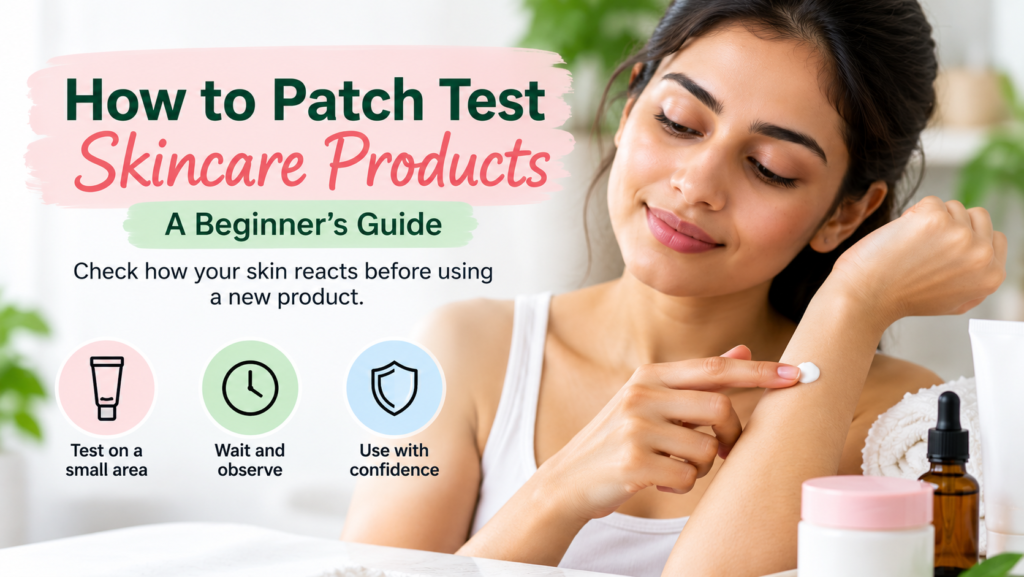

Have you ever bought a new serum or moisturizer and wondered whether it would suit your skin? Trying a new skincare product can be exciting, but it can also come with a little uncertainty—especially if your skin tends to become red, itchy or uncomfortable easily.
A simple patch test can help you check for some signs of irritation or an unwanted skin reaction before using a product more widely. Although it cannot guarantee that a product will never cause a reaction, it is a useful precaution when introducing something new into your skincare routine.
In this guide, you’ll learn how to patch test skincare products at home, where to apply them, how long to observe the area, and what to do if your skin reacts.
What Is a Skincare Patch Test?
A skincare patch test involves applying a small amount of a product to a limited area of skin and observing how the skin responds.
It can help you notice possible signs of irritation, such as redness, itching, swelling or a rash. However, a home patch test is not the same as professional allergy testing, and a negative result does not guarantee that a product will be suitable for your face.
Some reactions may develop after repeated use, and certain ingredients may cause problems only under particular conditions.
Why Should You Patch Test a New Skincare Product?
Even products labelled gentle, natural or suitable for sensitive skin can cause reactions in some people. Skin responses vary depending on the ingredients, product formulation and individual sensitivity.
Patch testing is particularly worth considering when introducing:
- A new serum or active ingredient.
- Exfoliating products containing acids.
- Retinol or other retinoid products.
- Fragranced creams, lotions or facial oils.
- Hair products that may come into contact with your face or neck.
You do not need to be worried about every new product. The aim is simply to introduce products thoughtfully instead of applying several unfamiliar formulas at once.
How to Patch Test Skincare Products at Home
Follow these steps to check how your skin responds to a new product.
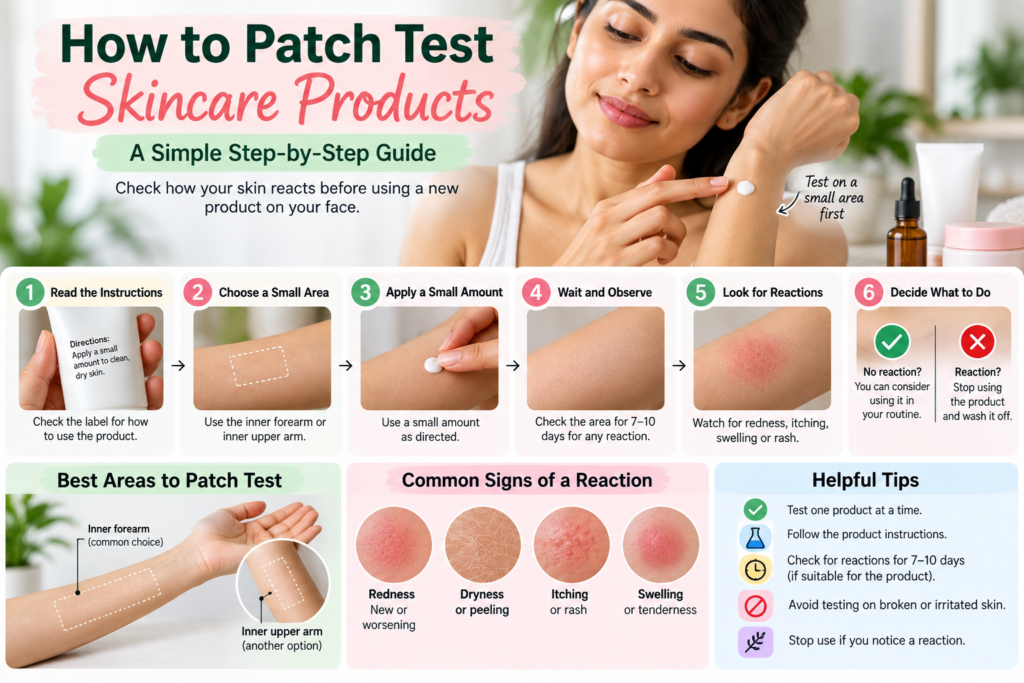
Step 1: Read the Product Instructions
Before testing, read the label carefully. Some products have specific instructions about how much to apply, how long to leave them on and how often to use them.
For rinse-off products, follow the recommended contact time rather than leaving the product on your skin longer than directed. Products containing strong active ingredients may require particular precautions.
Step 2: Choose a Small Area of Skin
For many leave-on skincare products, a small area on the inner forearm is a practical place to begin. Another suitable area may be the inner upper arm.
Choose skin that is clean, dry and free from cuts, rashes or existing irritation. Avoid testing a new product on broken skin.
Step 3: Apply a Small Amount
Apply a small amount of the product to the selected area, following the label directions. Do not cover the area with a bandage or other material unless the product instructions or a healthcare professional specifically advise it.
If you are testing several new products, test them separately rather than mixing them together.
Step 4: Follow the Recommended Use Instructions
For a leave-on product, use the amount and frequency recommended on its label. For a rinse-off cleanser or mask, follow the stated contact time.
For many ordinary leave-on skincare products, guidance may involve applying the product to a small area twice daily for seven to ten days. However, this is not appropriate for every formula. Do not repeatedly apply strong exfoliants or other potentially irritating treatments just to complete a test.
If the product has specific patch-testing directions, follow those instructions.
Step 5: Observe the Skin
Check the area during the testing period and after each application. Look for changes such as:
- Redness that is new or worsening.
- Itching or persistent burning.
- Swelling or tenderness.
- A rash, bumps or blistering.
- Dryness or peeling beyond what the product instructions describe.
A product can sometimes cause a delayed reaction, so do not assume that everything is fine just because your skin looks normal immediately after application.
Step 6: Decide Whether to Continue
If you notice a suspicious reaction, stop applying the product to the test area and wash it off if appropriate. Do not try to push through persistent burning, itching or redness.
If no reaction occurs during the test, you can consider introducing the product into your routine as directed. Start cautiously, particularly with active ingredients, and remember that a home patch test cannot guarantee that your face will tolerate the product.
Where Should You Patch Test Different Products?
The best test location depends on the product and its instructions.
| Product type | Practical guidance |
|---|---|
| Moisturizer | Test a small area of the inner forearm or upper arm if appropriate for the formula. |
| Face serum | Follow the label; a small area of the inner arm may be suitable for many leave-on formulas. |
| Exfoliating acid | Check the directions carefully and avoid repeated testing beyond the recommended use. |
| Retinol product | Follow the product’s introduction instructions and start cautiously. |
| Facial cleanser | Test according to its rinse-off directions and recommended contact time. |
| Sunscreen | Follow the label and consider testing a small area first, but remember that a patch test does not establish how well it protects against UV rays. |
Do not test products near your eyes, inside your nose or mouth, or on sensitive areas unless the product is specifically designed for that area.
What Does a Reaction to a Skincare Product Look Like?
Skin reactions can vary. Some are mild, while others need medical attention.
Possible irritation may include stinging, burning, redness, dryness or peeling. It can depend on the concentration of an ingredient, how often it is used and the condition of your skin.
Possible allergic contact dermatitis may involve itching, a rash, swelling or blistering. The reaction can sometimes appear hours or days after exposure.
These symptoms can overlap, so it is not always possible to identify the cause just by looking at the skin.
If you develop a reaction, stop using the product. Seek medical advice if symptoms persist, worsen or keep returning. Get urgent medical help for breathing difficulty or swelling of the lips, tongue or throat.
Common Patch-Testing Mistakes to Avoid
Testing Too Many Products at Once
If you test or introduce several products together, it becomes harder to identify which one may have caused a reaction. Introduce new products one at a time.
Testing on Already Irritated Skin
Skin that is already inflamed or damaged may respond differently. Wait until the area has settled, or seek professional advice before testing.
Applying More Than the Label Recommends
Using a larger amount or leaving a product on longer does not make the test more reliable. It may instead increase the chance of irritation.
Assuming a Negative Test Guarantees Safety
A small-area test cannot predict every reaction. Your face may respond differently, and some reactions develop only after repeated use.
Ignoring Persistent Discomfort
Mild, brief sensations can occur with certain formulas, but persistent burning, swelling or a rash should not be ignored. Stop use rather than trying to build tolerance through a suspected reaction.
How to Introduce a New Product After Patch Testing
Once a product has been patch tested without an obvious reaction, introduce it carefully:
- Add just one new product to your routine.
- Use it according to the product label.
- Avoid introducing several strong active ingredients at the same time.
- Keep your routine simple so you can notice changes in your skin.
- Stop using the product if a concerning reaction develops.
If your skin often reacts to products, or if you have a persistent skin condition, a qualified skincare or healthcare professional can help you decide which products and ingredients may be appropriate.
For more routine basics, read our guide on how to build a simple skincare routine for beginners. You can also learn what order to apply skincare products once you are ready to organize your routine.
Frequently Asked Questions
Q1. How long should I patch test a skincare product?
The duration depends on the product. Some leave-on products are commonly tested on a small area twice daily for seven to ten days, but this approach is not suitable for every formula. Always follow the product’s instructions, especially for exfoliants and strong active ingredients.
Q2. Can I patch test a product directly on my face?
A small area of skin may be used when the product instructions allow it, but avoid sensitive areas and do not apply it near your eyes. The inner forearm or upper arm is often a practical starting point for many products.
Q3. Can a patch test prevent all allergic reactions?
No. A home patch test may help identify some reactions, but it cannot rule out every allergy or guarantee that a product will not cause problems later.
Q4. Should I patch test natural or herbal skincare products?
Yes, it can be sensible to test these products too. Natural ingredients, essential oils and botanical extracts can also irritate the skin or cause allergic reactions.
Q5. What should I do if my skin reacts during a patch test?
Stop using the product and wash it off if appropriate. Avoid applying more of it to the affected area. Seek medical advice if the reaction is persistent, severe or worsening; breathing difficulty or swelling of the lips, tongue or throat requires urgent medical attention.
Conclusion:
Patch testing is a simple precaution that can help you notice some unwanted skin reactions before introducing a product more widely. Read the label, test a small area when appropriate, observe your skin and introduce new products one at a time.
Most importantly, remember that no home test can guarantee a product will suit everyone. Pay attention to how your skin responds and do not ignore persistent irritation.
Disclaimer: This article is for general informational purposes only and is not a substitute for professional skincare advice. Before trying any skincare product or changing your routine, consult a qualified skincare or healthcare professional to make sure it is suitable for your skin.
About Author


