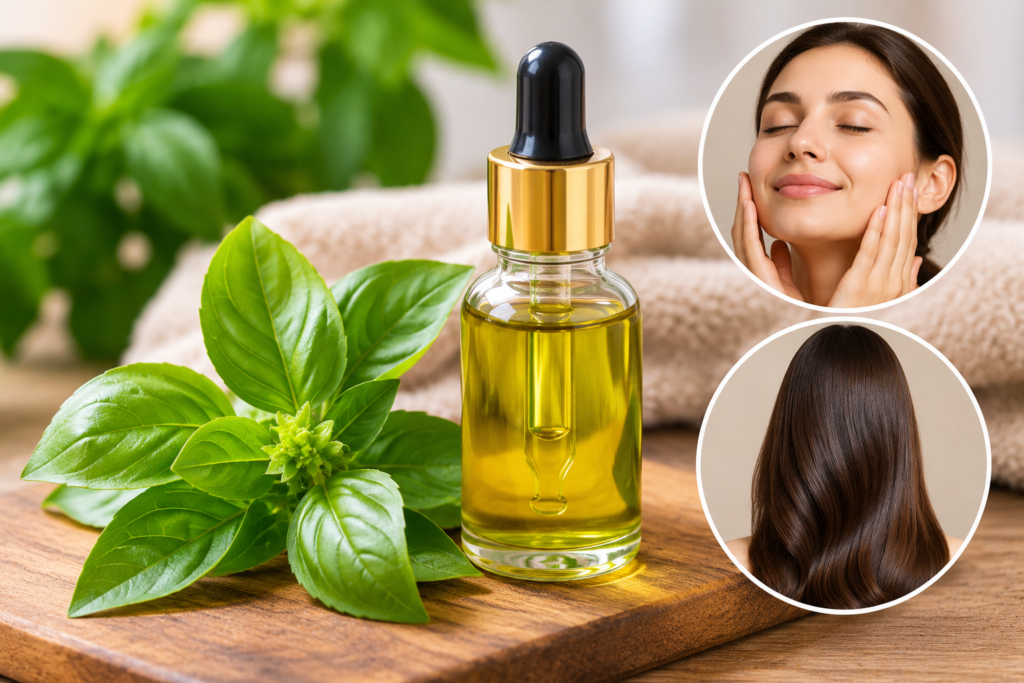

Basil is a familiar herb in many Indian homes. Commonly known as Tulsi or sweet basil, different basil varieties are used in cooking, traditional practices and personal care. Basil leaves contain naturally occurring plant compounds that have attracted interest in skincare and haircare research.
Basil oil is also used in some cosmetic and aromatherapy products. However, it is important to understand that basil essential oil is highly concentrated and is not the same as fresh basil leaves or basil-infused carrier oil.
Some laboratory studies have explored the antimicrobial and antioxidant properties of basil oil. These findings are interesting, but they do not prove that applying basil oil directly to your face or scalp will treat acne, remove wrinkles or promote hair growth.
Let’s look at what is currently known, how basil oil is used and what precautions to follow.
What Is Basil Oil?
Basil oil is obtained from basil plants, particularly through a process called steam distillation. Its composition can vary depending on the basil species, growing conditions and extraction method.
You may come across three different products:
- Basil essential oil: A concentrated aromatic extract obtained from basil plant material.
- Basil-infused oil: A carrier oil in which basil leaves have been infused.
- Basil leaf extract: An ingredient prepared from basil leaves and used in certain cosmetic formulations.
These products are not interchangeable. Their concentration, composition and intended uses can be different, so always check the product label before using one.
Potential Benefits of Basil Oil for Skin
Basil contains naturally occurring compounds that have been investigated for their antioxidant and antimicrobial properties. However, most research is still preliminary, and the results should not be treated as proof of a skincare treatment.
1. Contains Antioxidant Compounds
Basil contains plant compounds that have demonstrated antioxidant activity in laboratory research. Antioxidants are studied for their ability to help neutralise free radicals, which can contribute to oxidative stress.
This makes basil an interesting ingredient for cosmetic research. However, there is not enough human evidence to claim that basil oil prevents wrinkles or reverses visible signs of ageing.
2. Has Been Studied for Antimicrobial Properties
Some laboratory studies have examined basil essential oil against microorganisms, including bacteria associated with acne.
These findings may help researchers understand its potential cosmetic applications. However, laboratory results do not establish that applying ordinary basil oil to acne-prone skin will clear pimples.
If you experience frequent breakouts, choose skincare products formulated for acne-prone skin rather than relying on undiluted essential oils.
3. May Have Potential in Skin-Care Formulations
Basil oil has been investigated for its possible role in cosmetic formulations because of its plant-derived compounds.
Researchers are still exploring how these ingredients behave in properly prepared products. A well-formulated cosmetic product is different from applying a concentrated essential oil directly to the skin.
4. May Be Used in Aromatherapy
Basil essential oil has a distinctive herbal aroma and is sometimes used in aromatherapy.
Some people enjoy its fragrance in a diffuser as part of a relaxing environment. However, evidence that basil aromatherapy treats anxiety, depression or headaches is limited.
If you are exploring plant-based ingredients for your skincare routine, remember that a simple and consistent approach matters more than using too many products. Read our guide on Simple Skincare Routine for Beginners to understand how to build a basic routine for your skin.
Potential Benefits of Basil Oil for Hair
Basil oil is sometimes promoted as a natural solution for dandruff, hair fall and faster hair growth. These claims need to be treated carefully because good-quality human studies supporting them are limited.
Here is what you should understand before including it in your haircare routine.
1. Interest in Scalp-Care Formulations
The antimicrobial properties of certain basil extracts have attracted scientific interest. Researchers are exploring plant-derived ingredients for different cosmetic applications.
However, there is not enough clinical evidence to say that basil essential oil treats dandruff or scalp infections.
2. Scalp Massage May Feel Relaxing
A gentle scalp massage with a suitable, properly formulated hair oil may feel relaxing and help distribute the product through the hair.
The massage itself should not be confused with a proven hair-growth treatment. Basil oil has not been established as a reliable way to increase hair density or reverse hair loss.
3. Can Be Found in Herbal Hair Products
Some herbal haircare products include basil extracts or basil-derived ingredients as part of their formulation.
If you are interested in trying one, check the ingredient list and choose a product suitable for your scalp. Avoid products that make unrealistic promises about stopping hair loss or growing new hair quickly.
How to Use Basil Oil More Safely
Because essential oils are concentrated, using them directly on your face or scalp is not advisable.
If you are considering a basil-containing cosmetic product, follow these precautions:
- Choose a properly formulated cosmetic product from a reliable manufacturer.
- Read the ingredient list and follow the manufacturer’s instructions.
- Avoid applying concentrated essential oil directly to the skin.
- Do not use it on broken, irritated or inflamed skin.
- Avoid contact with the eyes, lips and sensitive areas.
- Stop using the product if you notice burning, redness, itching or swelling.
A patch test may help identify some reactions, but it cannot guarantee that a product will never cause irritation or allergy.
People with sensitive skin or a history of contact allergies should be particularly cautious.
Before introducing a new basil-containing skincare product, test it carefully to check how your skin responds. Follow our guide on How to Patch Test Skincare Products to learn the correct way to test a new product before adding it to your routine.
Who Should Avoid Using Basil Essential Oil?
Basil essential oil may not be suitable for everyone.
Take extra care if you:
- Have sensitive or easily irritated skin.
- Have eczema or another existing skin condition.
- Have previously reacted to essential oils or fragranced products.
- Are pregnant or breastfeeding and are considering using concentrated essential oils.
- Want to use the oil on a young child’s skin.
Seek advice from a qualified healthcare professional before using concentrated essential oils if you are unsure about their suitability.
Never swallow basil essential oil unless specifically directed by an appropriately qualified healthcare professional. Essential oils are concentrated products and are not ordinary dietary oils.
Basil Oil vs Basil Leaves: What Is the Difference?
Although both come from basil plants, they are different in concentration and use.
| Feature | Fresh Basil Leaves | Basil Essential Oil |
|---|---|---|
| Form | Fresh plant leaves | Concentrated aromatic extract |
| Common use | Cooking and traditional preparations | Aromatherapy and cosmetic formulations |
| Concentration | Whole plant material | Highly concentrated |
| Skin application | Not automatically suitable for every skin type | Requires particular caution and appropriate formulation |
| Research | Studied for plant compounds | Studied for volatile compounds and possible cosmetic uses |
Do not assume that because basil leaves are commonly used in food, concentrated basil essential oil is automatically safe to apply to the skin or consume.
FAQs.:
Q1. Is basil oil good for the skin?
Basil oil contains plant compounds that have been studied for antioxidant and antimicrobial properties. However, there is not enough strong human evidence to confirm that it treats acne, wrinkles or other skin conditions.
Q2. Can basil oil remove pimples?
There is preliminary laboratory research on basil oils and acne-associated bacteria, but this does not prove that basil oil removes pimples in everyday use. Choose suitable, tested acne-care products instead.
Q3. Does basil oil help with hair growth?
There is insufficient reliable human evidence to establish basil essential oil as a hair-growth treatment. Do not depend on it to treat hair thinning or hair loss.
Q4. Can basil oil help with dandruff?
Basil oil has not been established as a clinically proven dandruff treatment. If you have persistent flakes, itching or scalp irritation, consider an appropriate dandruff product or seek professional advice.
Q5. Can I apply basil essential oil directly to my face?
No. Concentrated essential oils can cause irritation or allergic reactions. Avoid direct application and choose a properly formulated cosmetic product instead.
Q6. Is basil oil the same as Tulsi oil?
The names can be confusing. Different basil species, including holy basil (Tulsi) and sweet basil, can produce oils with different chemical compositions. Check the botanical name on the product label rather than relying only on the common name.
Conclusion:
Basil oil is an interesting plant-derived ingredient with potential applications in cosmetic and aromatherapy products. Research has explored its antioxidant and antimicrobial properties, but many popular claims about acne treatment, wrinkle removal and hair growth are not yet supported by sufficient human evidence.
If you want to include basil-derived ingredients in your personal care routine, choose a properly formulated product and pay attention to how your skin and scalp respond. Avoid using concentrated essential oils directly, and do not replace established treatments with unproven home remedies.
Medical and Scientific References
- National Center for Complementary and Integrative Health (NCCIH) – Aromatherapy
- PubMed – Evaluation of in vitro antimicrobial activity of Thai basil oils against acne-associated bacteria
- PubMed Central – The Therapeutic Potential of Essential Oils in Managing Inflammatory Skin Conditions: A Scoping Review
- U.S. Food and Drug Administration – Aromatherapy and Essential Oils
- Johns Hopkins Medicine – Aromatherapy: Do Essential Oils Really Work?
Disclaimer: This article is for general informational purposes only and is not a substitute for professional skincare advice. Before trying any skincare product or changing your routine, consult a qualified skincare or healthcare professional to make sure it is suitable for your skin.
About Author


